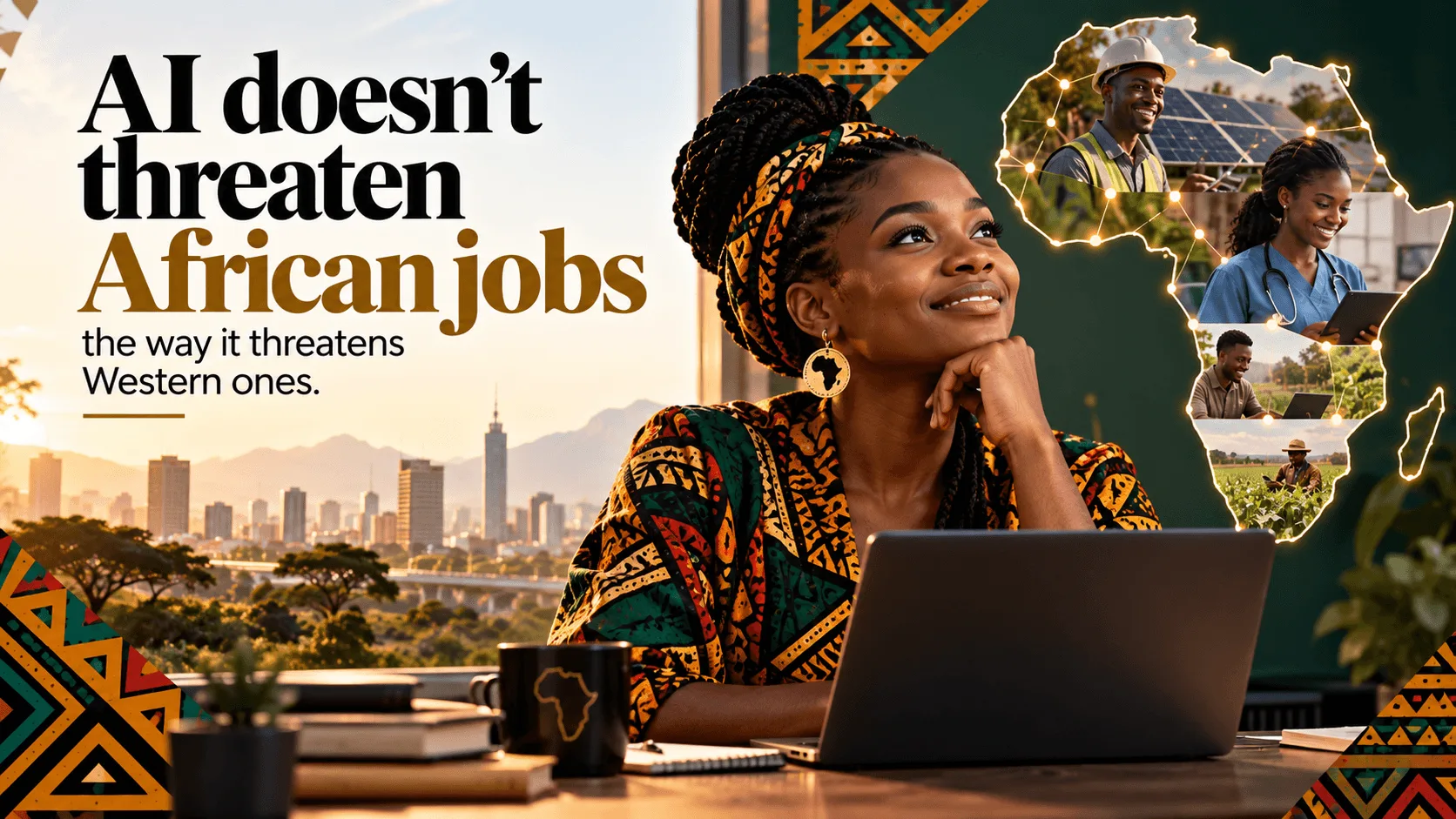
Scroll any feed, read any think-piece, and the anxiety is everywhere: AI is coming for the jobs. Lawyers, coders, writers, analysts — all nervously watching the machines get better. It's the defining fear of the moment in San Francisco and London.
Then you look at the data for Africa, and something strange happens. The fear inverts. According to the World Bank's World Development Report 2026, only about 4.5% of jobs in developing economies are highly exposed to automation — compared to more than 14% in advanced economies. Read that again. The rich world, with its knowledge-work economies, is three times more exposed to AI disruption than the developing world.
That single statistic flips the entire narrative. And most people — including a lot of smart African founders — are drawing exactly the wrong conclusion from it. Let me explain why "Africa is less exposed to AI job loss" is not the comforting footnote it sounds like. It's actually one of the most important strategic facts on the continent.
Why African jobs are less exposed (and why that's not just good news)
First, the mechanics. Why is a developing economy less exposed to AI automation? Because AI, in its current form, is best at automating cognitive, digital, desk-based work — the exact jobs that dominate advanced economies. Drafting documents, writing code, analyzing spreadsheets, processing information. If your economy is mostly people at keyboards, AI is a direct threat to a huge share of your workforce.
Africa's economies are structured differently. A far larger share of work is physical, informal, relational, and on-the-ground — the farmer, the trader, the artisan, the driver, the hands-on service worker. That work is, for now, largely out of reach of a language model. So the continent is genuinely more insulated from the wave of white-collar automation panicking the West.
But here's where the naive reading goes wrong. "Less exposed" can mean two very different things. It can mean protected — or it can mean left out. The same fact that shields African jobs from AI disruption could also mean African workers are on the sidelines of the biggest productivity revolution in a century, watching the rest of the world get radically more productive while they don't. Insulation from a wave is only good if you didn't want to ride it.
So the real question isn't "will AI take African jobs?" It's the far more interesting: will Africa use AI to leapfrog, or will low exposure become an excuse to sit the revolution out?
The opportunity hiding inside the statistic
Here's the reframe that changes everything. In the West, AI is largely a threat to be managed — it displaces existing, well-paid knowledge workers, and the political conversation is about protecting them. In Africa, AI is largely a tool to be seized — because it's not competing with a large entrenched class of desk workers, it can be pointed at the continent's actual problems without the same fight.
Think about what that means concretely. AI as a force multiplier where there aren't enough skilled people to go around:
One doctor becomes ten. In regions with a handful of specialists for millions of people, AI diagnostic tools don't replace doctors — there aren't enough to replace. They extend the few that exist, letting a nurse or a clinic do more.
One teacher reaches thousands. Where classrooms are overcrowded and teachers scarce, AI tutors in local languages don't threaten a teaching workforce — they augment an overstretched one.
Every small business gets a back office. The trader who could never afford an accountant, a marketer, or an analyst can now have versions of all three. AI doesn't take that job — it creates a capability that never existed.
In a labour market defined by shortages of skilled cognitive work rather than surpluses of it, AI is additive, not substitutive. It fills gaps instead of taking seats. That's the opposite of the Western dynamic, and it's why the same technology that's a threat there is an opportunity here.
The catch nobody should skip
I won't pretend this is automatic or painless. Low current exposure doesn't mean zero exposure forever — as AI moves into physical work through robotics, and as African economies build more digital jobs, the calculus will shift. And the "AI augments scarce labour" dream only works if people can actually access the tools: the connectivity, the devices, the skills, the local-language models. Without those, the productivity revolution simply routes around the people who need it most, and the gap with the rest of the world widens instead of closing.
That's the honest tension. The statistic hands Africa an unusual window — less to fear, more to gain — but a window is not an outcome. It's a chance that has to be taken deliberately.
Offense, Not Defense
- The West plays defense — protecting jobs, managing displacement, fighting over who loses.
- Africa can play offense — deploying AI into an economy where it mostly adds capability instead of destroying it.
- "Less exposed" is a window, not an outcome. It only becomes a leapfrog if people can actually access the tools.
The rest of the world is spending this decade playing defense against AI — protecting jobs, managing displacement, fighting about who loses. Africa has the rare chance to play offense — to deploy AI into an economy where it mostly adds capability rather than destroying it.
That's the opportunity buried in a statistic everyone's misreading. "Africa is less exposed to AI job loss" isn't a reason to relax. It's a reason to move faster than everyone else, precisely because the continent can adopt this technology without the brutal internal fight the West is having. The builders who see AI in Africa as a multiplier for a labour-scarce economy — not a threat to be feared, and not a wave to sit out — are the ones reading the data right. Everyone else is importing a fear that was never really ours to begin with.
References
- Techpoint Africa / World Bank WDR 2026 — African AI language models and the automation exposure gap
- African Leadership Magazine — Africa's AI Imperative: Avoiding Data Colonisation Through Sovereignty
- Business Day — Africa's AI ambition hits an expensive reality of compute, power, compliance