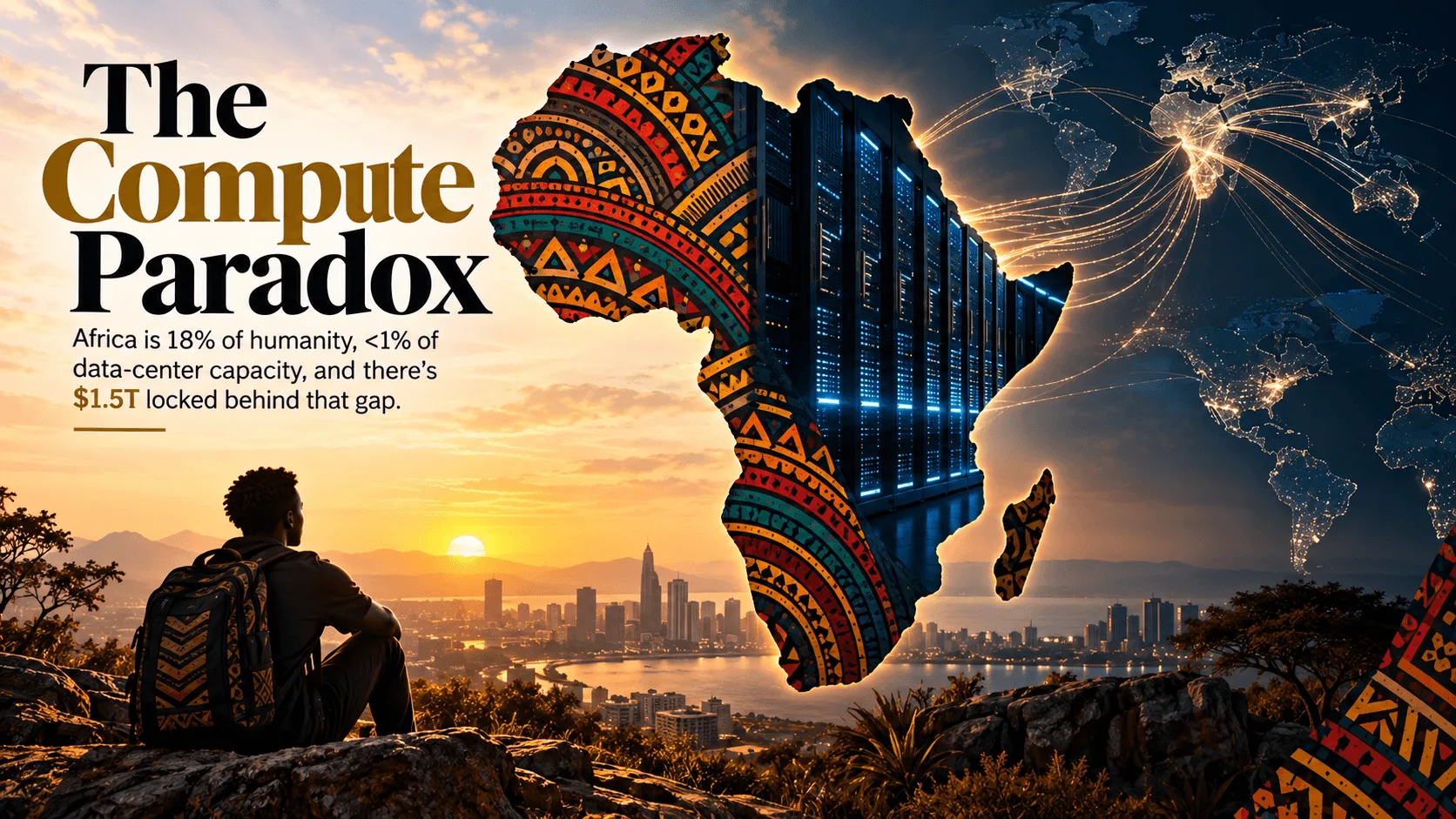
Here is a number that should stop every African founder cold. Africa is home to roughly 18% of the world's population — and holds less than 1% of the world's data-center capacity. Less than that, when you count the GPUs that actually power AI.
Sit with the distance between those two figures for a second, because it isn't a statistic. It's a warning. In the age of artificial intelligence, compute — the raw processing power that trains and runs AI — is the new oil, the new electricity, the new factory floor. It is the thing everything else is built on. And Africa, right now, owns almost none of it.
Everyone's talking about African AI startups, African AI talent, African AI use cases. Those are real and they matter. But there's a harder truth underneath the optimism, and almost nobody wants to say it plainly: if Africa doesn't own the compute, Africa doesn't own the AI. It just rents it. And renting the most important technology of the century is not a strategy. It's a trap.
Why compute is the thing that actually matters
Let me be concrete about why this is the whole game, not one issue among many.
Every AI system — every model that answers a question, detects a crop disease, reads a medical scan, powers a chatbot — runs on physical infrastructure: specialized chips, in data centers, drawing enormous power. That infrastructure is compute. When you use an AI tool today in Lagos or Nairobi or Harare, the actual computation is almost always happening on a server in Virginia, or Ireland, or increasingly China. Your data leaves the continent, gets processed on someone else's machine, and the answer comes back.
That arrangement has three consequences people underestimate:
Your data lives on someone else's territory. The most sensitive assets in any economy — financial records, health data, government information, business secrets — get processed abroad, under someone else's laws and someone else's control. That's not a privacy footnote; it's a sovereignty problem.
You pay rent forever. Every API call, every model query, every AI workload is a payment to an infrastructure owner outside Africa. Multiply that across a continent adopting AI fast, and you've built a permanent, compounding outflow of money for the privilege of using intelligence you don't own.
You can't build what you can't run. You cannot train a large model — say, one that actually understands African languages and contexts — without massive local compute. No compute means no homegrown frontier AI, which means Africa is stuck consuming models built elsewhere, for elsewhere, forever a step behind.
Compute isn't one factor in African AI. It's the foundation the entire building stands on. And the foundation is missing.
The $1.5 trillion sitting behind the gap
Here's where it turns from warning to opportunity, because the flip side of a massive gap is a massive prize. The World Economic Forum estimates that breaking Africa's "compute paradox" — the strange situation of enormous demand for AI and almost no infrastructure to serve it — could unlock $1.2 to $1.5 trillion in economic value by 2030.
That is not a rounding error. That is a generational opportunity, and it exists precisely because the gap is so wide. When you're at less than 1% of global capacity, the room to grow isn't incremental — it's exponential. The money already knows this: Cassava Technologies is deploying thousands of NVIDIA GPUs across South Africa, Nigeria, Kenya, Egypt, and Morocco. Infrastructure funds and development finance institutions are committing billions specifically to African digital infrastructure. Africa's data-center market is on track to grow at a compound rate near 16% a year. The capital is beginning to move because everyone serious can see the size of the hole and the size of the demand.
But — and this is the part that matters for anyone building — capital flowing in is not the same as Africa owning the outcome. The question isn't whether data centers get built on African soil. It's who owns them, who controls them, and whether Africans capture the value or just host the machines. There's a version of this future where Africa's compute is built and owned by foreign hyperscalers, and the continent ends up a tenant on its own land. And there's a version where African companies, African capital, and African talent build and own the infrastructure — and capture the trillion-dollar prize.
The uncomfortable question for builders
So here's the thing I want you to sit with, whether you're a founder, an investor, or a policymaker.
We spend enormous energy celebrating African AI applications — the clever startup using AI to do something useful. That's good. But applications built on rented compute are castles on borrowed land. The company in Virginia that owns the servers can change its prices, its terms, or its access policy, and every application on top of it inherits that vulnerability. You are only as sovereign as your infrastructure.
The Layer That Actually Matters
- Applications on rented compute are castles on borrowed land. The server owner can change prices, terms, or access — and every app inherits that risk.
- The gap is the opportunity. Less than 1% of global capacity means exponential room to grow, and up to $1.5T behind it by 2030.
- Built on African soil isn't the same as African-owned. The real question is who captures the value — owners, or hosts.
The builders and backers who understand this are looking one layer down — at the unglamorous, capital-heavy, deeply strategic work of compute itself: the data centers, the GPU access, the power to run them, the local cloud. It's harder than building an app. It's slower. It needs patient capital and real infrastructure. And it's exactly where the trillion dollars, and the sovereignty, actually live.
Africa being 18% of humanity and less than 1% of the world's compute is either the continent's greatest vulnerability or its greatest opportunity — and which one it becomes is being decided right now, in the next few years, by who chooses to build the foundation instead of just the floors above it. The gap is the game. The question is who's playing to own it, and who's content to keep renting.
References
- World Economic Forum — Investment in 'green' computing can unlock $1.5t in Africa
- Introl — Africa's AI Data Center Boom
- Ecofin Agency — From Cloud to AI: Africa's Data Center Market's Next Growth Phase
- Xalam Analytics — Africa Data Center Report 2026