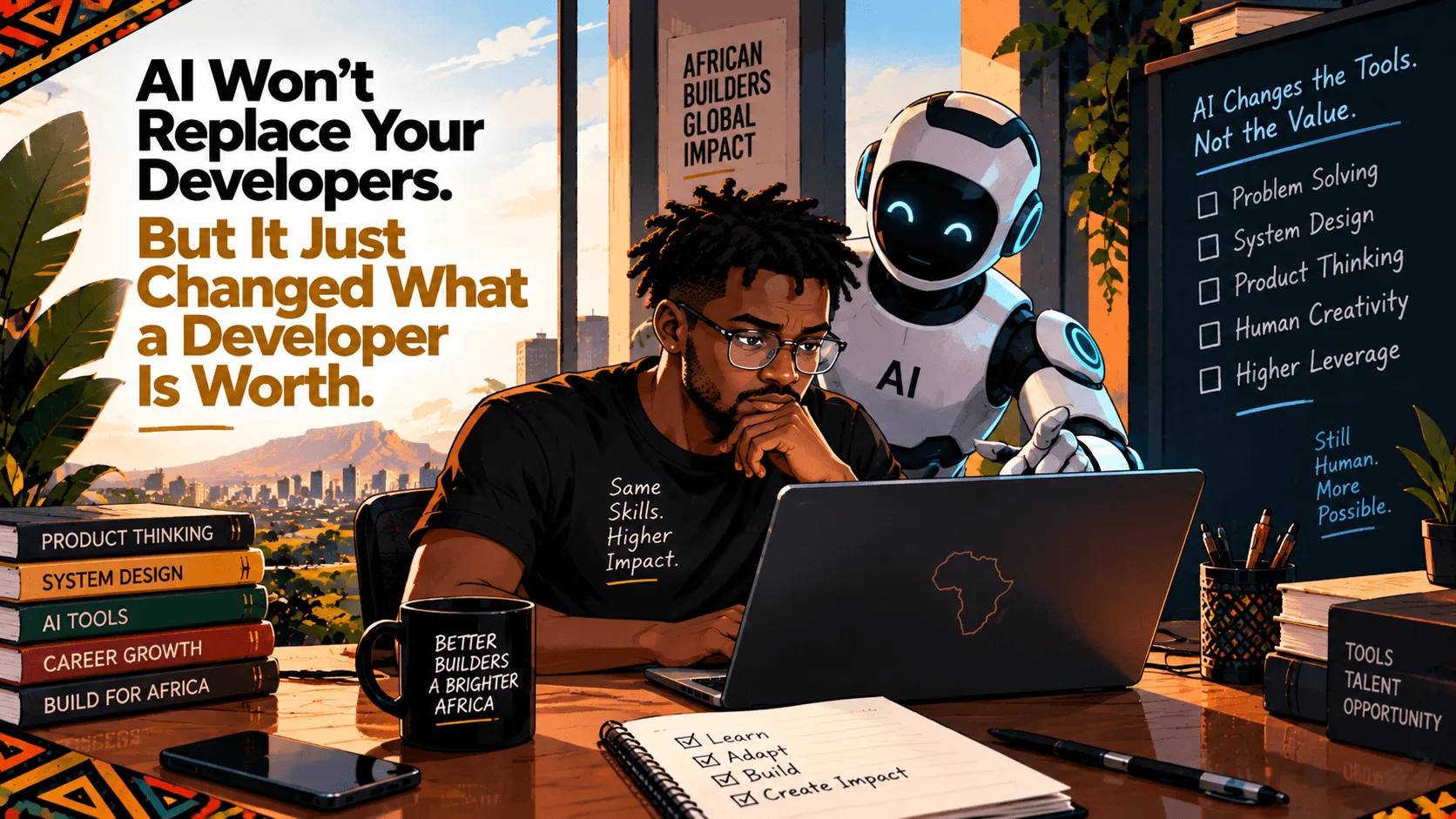
There are two loud, wrong opinions about AI and software development, and they're drowning out the truth that actually matters for your business.
The first wrong opinion: "AI will replace all developers — soon you won't need them at all, just describe what you want and the machine builds it." The second wrong opinion, usually from developers: "AI is just hype, a fancy autocomplete, it doesn't really change anything about how we work." Both are comforting. Both are false. And if you're a business owner making decisions about building software, believing either one will cost you.
The truth is more interesting and more useful: AI won't replace your developers — but it has fundamentally changed what a developer is worth, and where that worth comes from. Understanding that shift is now a business decision, not a technical one. Let me explain what actually changed.
What AI actually does to software development
Here's what's real, stripped of both the hype and the denial. AI has become genuinely, dramatically good at the mechanical parts of writing software — generating boilerplate code, drafting standard functions, writing routine tests, translating between languages, explaining what a piece of code does. The parts of programming that were once slow, manual typing are now fast. A developer with good AI tools can produce the raw material of software several times faster than before.
That's not hype. It's a real, large productivity shift, and any developer or business pretending otherwise is going to be outcompeted by those who aren't.
But — and this is the whole point — writing code was never the hard or valuable part of building software. It felt like the job because it took the most time. AI didn't automate the valuable part. It automated the time-consuming part. And those turn out to be very different things.
The part AI didn't touch (and can't, yet)
So what's left? Everything that actually determines whether software succeeds. And it's precisely the stuff that makes projects live or die:
Understanding the real problem. AI can write code to a specification, but it can't sit with a business owner, watch how they actually work, and figure out what they truly need versus what they said they need. That translation from messy human reality to a clear problem definition is the highest-value work in software, and it's deeply human.
Judgment about what to build. Deciding what to include and what to leave out, what matters and what's noise, how the pieces should fit — that's architecture and product judgment, earned through experience and context AI doesn't have.
Knowing when the AI is wrong. This is the underrated one. AI generates code confidently, including code that's subtly broken, insecure, or wrong for your specific situation. It takes an experienced developer to catch that — to look at plausible-looking output and know it's a trap. AI raises the floor of code production and simultaneously raises the need for judgment to supervise it. The more code AI writes, the more you need someone who can tell good from bad at a glance.
Owning the outcome. AI doesn't take responsibility. When the software has to work — when money or health or a business depends on it — someone human has to own that it's correct, secure, and fit for purpose. That accountability can't be automated.
So the developer didn't get replaced. The developer's job moved up the stack — from typing code to directing, judging, and owning it. The typing got cheap. The thinking got more valuable, not less.
What this means for what a developer is worth
Here's the reframe that matters for your business. The value of a developer used to be substantially tied to their ability to produce code — to build the thing. That component is now largely commoditized by AI. What's left, and what's now worth more than ever, is the judgment: understanding the problem, making the right calls, catching what the AI gets wrong, and owning the result.
This splits developers into two groups, and the gap between them is widening fast. The developer who was only a code-typist — who could implement a spec but not understand a business, not exercise judgment, not catch AI's mistakes — is worth dramatically less than before, because AI does the commodity part of their job. But the developer who brings judgment, problem-understanding, and ownership, supercharged by AI doing the mechanical work — that developer is worth far more than they were two years ago, because they now deliver several times the output with the same irreplaceable judgment on top.
The lesson for a business owner: when you're evaluating who builds your software, stop assessing raw coding ability — AI made that cheap — and start assessing judgment, problem-understanding, and ownership, because that's the part that now determines whether your software succeeds. The right question is no longer "can they code?" Nearly anyone with AI can produce code. The question is "do they understand my problem, exercise good judgment, and take ownership of the outcome?" That's what you're actually paying for now.
What to take from this
AI didn't kill software development. It clarified it — by automating the part that was time-consuming but never the point, and leaving exposed the part that always mattered: human judgment applied to a real problem, with someone accountable for the result. The builders who thrive in this era are the ones who use AI to move faster on the mechanical work while doubling down on the judgment AI can't provide. The ones who defined themselves purely by code output are in trouble.
For your business, that means the value you should look for in whoever builds your software has shifted — up, toward understanding and judgment and ownership, and away from raw coding you can now get from a machine. Get that evaluation right and AI makes your software cheaper and better. Get it wrong — hire the commodity, skip the judgment — and AI just helps you build the wrong thing faster than ever.
At Neocube, we build with AI woven into everything we make — which means our clients get software faster and cheaper than the old way allowed. But the reason it actually works is the judgment on top: we invest in understanding your real problem, making the right calls, and owning the outcome, and we let AI accelerate the rest. That combination — AI speed plus human judgment plus real ownership — is exactly what building software should look like now.
See what we're building →