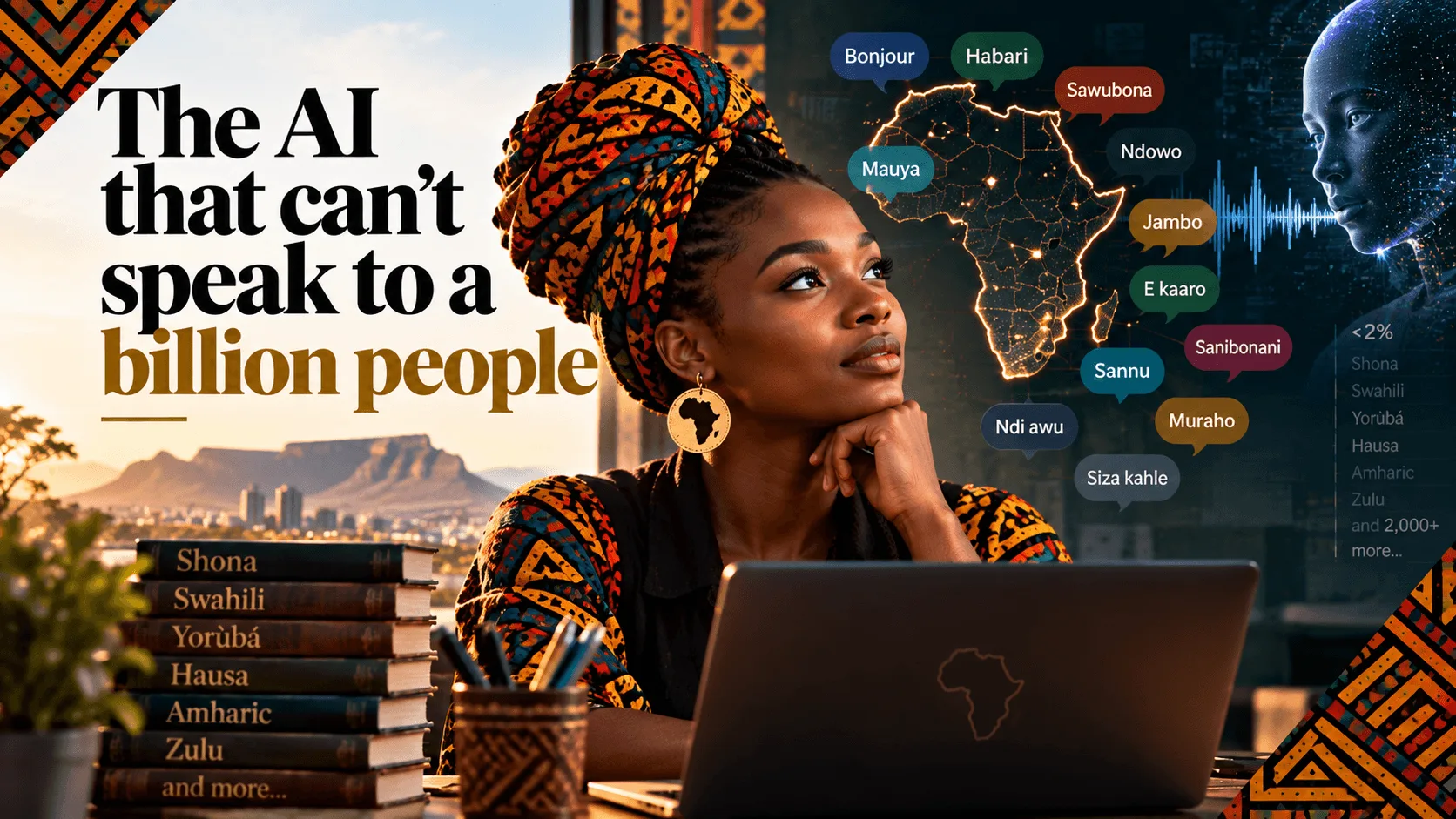
Ask the most advanced AI model on earth a question in English and it will astonish you. Ask it the same question in Yoruba, Hausa, Chichewa, or any of hundreds of African languages, and it falls apart — often confidently, often producing nonsense, sometimes producing something worse. A study by the Masakhane research initiative found that state-of-the-art large language models perform reasonably in English and French but fail catastrophically in around 90% of Africa's roughly 2,000 languages.
There's a reason, and it's stark: less than 2% of the data these models are trained on meaningfully represents African languages or contexts. The most powerful technology of our era was built almost entirely without Africa in the room, and it shows the moment you speak to it in an African tongue.
Most people hear this and file it under "unfortunate gap, someone should fix it." I want to argue something sharper: this isn't just a gap. It's one of the largest untapped markets in technology — a door standing wide open, with almost nobody through it yet. And the people who walk through it are going to build something enormous.
Why this is a market, not a charity case
It's easy to frame African-language AI as a social good — inclusion, dignity, access. It is all of those. But framing it only that way misses the commercial reality, and the commercial reality is what will actually get it built at scale.
Here's the market logic. Hundreds of millions of Africans are effectively locked out of the digital economy by language. They can't fully use AI-powered tools — in education, healthcare, finance, government services — because those tools don't speak to them. Every one of those people is a customer the current technology cannot serve. Whoever builds AI that does speak to them isn't doing charity; they're unlocking a customer base of a scale that barely exists anywhere else on earth still untapped.
The GSMA estimates that closing this language gap helps push mobile's contribution to Africa's economy from around $240 billion in 2025 toward $290 billion by 2030. That's not a feel-good number — that's addressable market expanding because people who couldn't transact digitally suddenly can. Language isn't a soft issue here. It's the key to the lock on hundreds of millions of consumers.
And the striking part: the incumbents largely can't or won't serve it. The global AI giants are optimizing for the languages with the most data and the biggest existing markets. Africa's linguistic diversity — 2,000+ languages, many with little digital text — is exactly the kind of hard, fragmented, unglamorous problem they deprioritize. That neglect is the opening. The gap the giants ignore is the market local builders can own.
It's already starting — which means the window is now
This isn't theoretical, and that's what makes it urgent. The race has quietly begun.
Lelapa AI, out of Johannesburg, launched InkubaLM — a "small language model" focused on Swahili, Hausa, Yoruba, isiZulu, and isiXhosa, that performs comparably to much larger models at a fraction of the size, deliberately built for Africa's infrastructure constraints. Six of Africa's biggest telecom operators — Airtel, Axian, Ethio Telecom, MTN, Orange, and Vodacom — joined forces under a banner that says it all: "AI language models in Africa, by Africa, for Africa." They've already produced the first open Swahili reasoning model. Research collectives like Masakhane and the Deep Learning Indaba have built a whole decentralized research culture across the continent.
The pattern here matters. The smart money and the smart builders have realized that African-language AI is both a massive market and a sovereignty issue — and they're moving. Which means the window where this is wide open is now, not in five years. The datasets are being built, the models are being trained, the standards are being set. The people laying that foundation today are the ones who'll own the rails everyone else builds on tomorrow.
Why "small" is the secret weapon
One more thing worth understanding, because it's counterintuitive and it's an advantage. The instinct is to think you need a giant model — the kind only a trillion-dollar company can afford — to compete. African-language AI is proving the opposite.
InkubaLM works well with only 0.4 billion parameters — tiny by frontier standards — because it's focused. A model built specifically for five African languages, tuned for low connectivity and limited power, can outperform a giant general model on the thing that actually matters: serving those languages, on the devices and networks people actually have. Small, specialized, and locally-built beats big, general, and foreign — for this market. That flips the usual "you can't compete with the giants" logic on its head. In African-language AI, being small and local isn't a disadvantage. It's the whole edge.
Why This Door Is Wide Open
- Enormous demand: hundreds of millions locked out of the digital economy by language alone.
- Incumbent neglect: the giants deprioritise 2,000 fragmented, low-data languages.
- Small beats big here: focused 0.4B-parameter models outperform giants on the languages that matter — and local builders can actually ship them.
The most powerful AI in the world is functionally deaf to a billion people. The global giants aren't rushing to fix it because the market is fragmented, the data is scarce, and it's not their priority. That combination — enormous demand, incumbent neglect, and a technical approach (small, focused models) that local builders can actually execute — is about as clear an opportunity signal as technology ever gives you.
If you're building in African tech and looking for where the ground is most open, look at language. Not as a social mission — though it is one — but as one of the largest underserved markets on the planet, with the incumbents looking the other way. The AI that speaks to Africa hasn't been fully built yet. Whoever builds it doesn't just do a good thing. They own the door that a billion people walk through to reach the digital economy. That door is open right now. It won't be for long.
References
- Nature Middle East — As AI giants duel, the Global South builds its own brainpower
- African Leadership Magazine — Africa's AI Imperative: Avoiding Data Colonisation Through Sovereignty
- Techpoint Africa — How Africa's top mobile operators are building AI language models
- African Leadership Magazine — Africa's Data Sovereignty Push Sparks A New Race For Local Language AI