Here's a pattern I've watched sink more software projects than any technical failure ever has. A founder has an idea. Instead of shipping something small and rough, they spend six months — sometimes a year — building the "complete" version. Every feature. Polished. Perfect. They launch it to silence, because it turns out the market wanted something different, and now the money and the time are gone.
Then there's the other founder. She ships something slightly embarrassing in six weeks — clunky, missing features, held together with tape. People use it. They complain. They ask for things. And every complaint is a map. Six months later she has a product the market actually wants, built on real feedback, for a fraction of the cost.
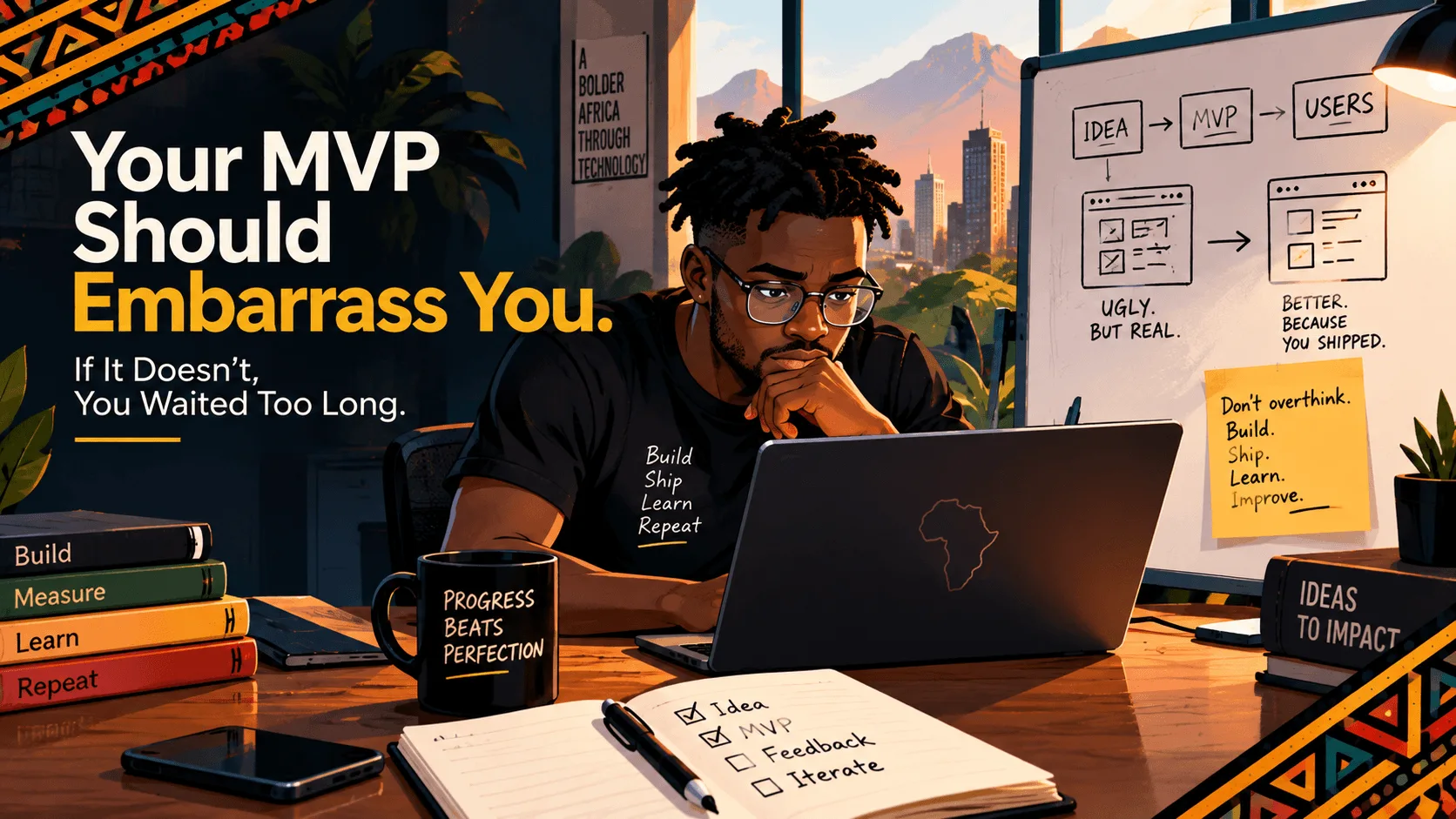
The difference between those two founders isn't talent or funding. It's a single, counterintuitive belief: your first version should embarrass you a little. If you're proud of your MVP, you almost certainly waited too long to ship it. Let me explain why that's not just a cute startup slogan, but the most important discipline in building software.
What an MVP actually is (and what everyone thinks it is)
MVP stands for Minimum Viable Product, and almost everyone gets the emphasis wrong. They hear "product" and build a small, polished, complete thing. The word that actually matters is minimum — the smallest thing you can put in front of real users to learn whether you're solving a real problem.
An MVP is not a smaller version of your final product. It's an experiment wearing the costume of a product. Its job isn't to impress. Its job is to teach you something you can't learn any other way — namely, whether anyone actually wants this, and what they'll really use.
That reframe changes everything. If the MVP is an experiment, then "is it polished?" is the wrong question. The right question is "did it teach me something?" And a rough thing in the market teaches you infinitely more than a perfect thing still in development. This is why the embarrassment is a feature. A slightly embarrassing MVP means you optimized for learning speed over pride — which is exactly the right trade when you don't yet know if you're building the right thing at all.
Why building the "complete" version first is so dangerous
The instinct to build everything before launching feels responsible. It's actually the riskiest thing you can do, and here's the precise reason: you are making every expensive decision at the exact moment you know the least.
Before you have real users, every feature you build is a guess. Which ones matter, how they should work, what the workflow should be — all guesses. Build the complete version up front and you're pouring the most time and money into a pile of untested assumptions. When the market finally speaks, you discover half of what you built, nobody wanted, and the half they did want, you built wrong. You've spent your biggest budget buying your least reliable information.
The rough-MVP founder does the opposite. She spends a little to learn a lot, then spends the real money once she knows. Every dollar after launch is aimed by evidence instead of guesswork. That's not being scrappy for its own sake — it's putting your capital where the uncertainty is lowest. In a world where most software ideas are at least partly wrong on the first try, the ability to be wrong cheaply and fast is the entire game.
There's a metaphor I keep coming back to: building the complete version first is like drawing a detailed map of a city you've never visited. It'll be beautiful, confident, and wrong in all the ways that matter. The MVP is walking the first few streets and drawing as you go.
The discipline is knowing what to leave out
Here's where MVP thinking gets genuinely hard, because "ship something minimal" is easy to say and brutal to do. Every instinct — and every stakeholder — will push you to add "just one more thing." The skill isn't building the MVP. It's having the discipline to leave things out.
The trick is to ruthlessly separate the one core thing your product must do from everything that's merely nice. If you're building a booking tool, the core is: can someone book? Not the dashboard, not the analytics, not the fifteen settings — those come after the market confirms people want to book through you at all. Almost everything you're tempted to build for launch can wait, and the founders who succeed are the ones who can look at a long feature list and say "not yet" to 80% of it.
This is also where "embarrassing" and "broken" part ways, and the distinction matters. An MVP should be embarrassingly small — few features, rough edges, missing polish. It should not be embarrassingly broken — the one thing it does, it must do reliably. Minimal scope, solid execution of that scope. A booking tool with no analytics is a fine MVP. A booking tool that loses bookings is just a bad product. Trim features aggressively; never trim trust.
What to take from this
The founders who win at software aren't the ones who build the most impressive first version. They're the ones who ship the smallest useful thing fastest, learn from real users, and let reality — not their assumptions — direct where the money goes next. They treat version one as a question, not a monument.
So if you're sitting on a big, polished build plan, waiting until it's "ready," here's the honest challenge: you're not being careful. You're being slow, and you're spending your biggest budget on your weakest information. Ship the embarrassing version. Let the market correct you while it's still cheap to be corrected. The pride you feel building the perfect thing in private is the most expensive feeling in software.
At Neocube, this is exactly how we build. We start our clients with a focused first version that solves the one core problem, get it into real users' hands fast, then grow it on actual feedback — with AI built in from day one. If you've got an idea and you're tempted to build everything before launching, talk to us first. We'll help you ship the right small thing instead of the wrong big one.
Build it right with Neocube →