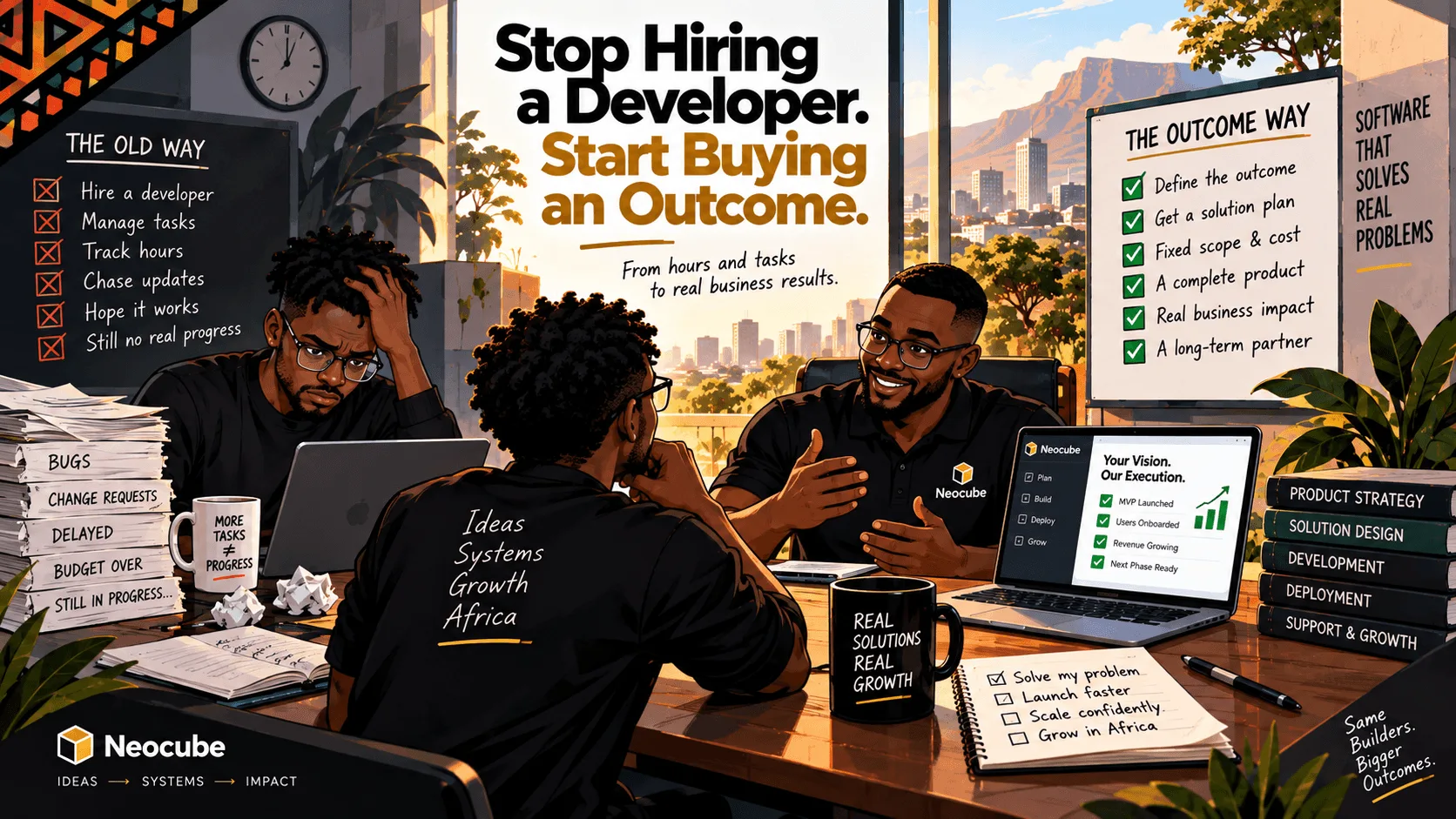
When a business needs software, its first instinct is almost always the same: "let's hire a developer." A freelancer, an agency by the hour, maybe a junior in-house. It feels like the obvious move. It's also, for most businesses, the wrong one — and it's the reason so many end up with half-built systems, blown budgets, and a pile of code nobody owns.
The problem isn't the developers. It's the framing. When you hire a developer, you're buying hours of code-writing and hoping they add up to something that solves your problem. But you don't actually want code. You never did. You want an outcome — a problem solved, a business running better — and code is just one ingredient in that. The businesses that get software right are the ones that stop buying hours and start buying outcomes. Let me explain the difference, because it's worth real money.
What you're actually buying when you "hire a developer"
Let's be precise about what the hire-a-developer model gets you. You pay for someone's time to write code. That's the transaction: hours in, code out. Everything else — figuring out what to build, whether it's the right thing, whether it'll actually work for your business, whether it's maintained after launch — is either your problem or nobody's.
See the gap? You wanted your business to run better. What you bought was code. And the distance between "code" and "business running better" is enormous — it's full of all the things that actually determine success: understanding the real problem, making good judgment calls, protecting the scope, catching mistakes, owning the result, caring for it after launch. When you buy hours of coding, all of that is unowned. You're the general contractor of a project you don't know how to run, hoping the pieces come together. Usually, they don't.
This is why the model fails so often. It's not that the developer is bad. It's that "a person writing code" is only a fraction of what turning a business problem into working software actually requires — and the hourly-hire framing quietly makes the hardest, most important parts nobody's job.
The shift: from inputs to outcomes
Here's the reframe that changes everything. Stop thinking about the input (developer hours, lines of code) and start thinking about the outcome (the problem solved, the result delivered). Those are two completely different things to buy, and they align incentives in opposite directions.
When you buy inputs — hours — the incentives are quietly misaligned. More hours means more money for whoever you hired, so there's no pressure to be efficient, and there's no one accountable for the actual result, only for the hours logged. You can pay for a hundred hours of perfectly good coding and still not have your problem solved, and technically nobody did anything wrong.
When you buy an outcome, the incentives flip and align with yours. Now the person you're paying is responsible for the result, not the hours — so they're motivated to understand your real problem (because solving the wrong one means they failed), to be efficient (because padding hours isn't how they win), to exercise judgment and catch mistakes (because they own whether it works), and to care about it after launch (because the outcome has to keep being delivered). Buying outcomes doesn't just feel better — it structurally aligns the builder's incentives with your success in a way that buying hours never can.
This is the difference between hiring a hand to hold a paintbrush and commissioning a finished painting. In the first, you're responsible for the result and just renting the labour. In the second, someone takes responsibility for delivering the thing you actually wanted.
What buying an outcome looks like in practice
So what does this mean concretely, if you're a business owner who needs software?
It means shifting how you evaluate and buy. Instead of "how much per hour and how many hours?", you ask "what outcome are you committing to, and who owns whether it's delivered?" Instead of a pile of code handed over with a shrug, you want a partner who takes responsibility for the whole distance from your problem to working software that solves it — and stays accountable for it working, not just for having written it.
Practically, that shows up as a few things. Someone who starts by understanding your business and problem, not by asking what features you want built. A defined result you're paying for, with clear ownership of whether it's achieved. A structure where the builder is motivated to be efficient and get it right, not to maximize billable time. And a relationship that continues past launch, because an outcome isn't "delivered" the day the code ships — it's delivered when your business is actually running better, and stays that way.
That's the model that works. Not because the people are more talented, but because the incentives and the ownership are structured around your success instead of around hours logged. When someone's on the hook for the outcome, all the hard, un-glamorous, project-saving work — understanding, judgment, scope discipline, maintenance — becomes their job to get right, because their success is defined by yours.
What to take from this
If you need software and you're about to hire a developer by the hour, pause and reframe. You don't want code. You want a problem solved. The moment you start buying outcomes instead of inputs, everything improves: the incentives align with your success, someone owns whether it actually works, and the hardest parts of building software stop being nobody's responsibility.
The businesses that win with software aren't the ones who found the cheapest developer or logged the most hours. They're the ones who understood that they were buying an outcome all along — and refused to settle for a pile of code and a hope. Buy the result, not the hours. Insist on ownership. That single shift in how you think about building software will save you more money and heartbreak than any technical decision you'll ever make.
This is the whole idea behind how Neocube works. We don't sell you developer hours and walk away — we take ownership of the outcome: understanding your real problem, building the software that solves it (with AI built in), and staying accountable for it working through an ongoing care plan. Our products, like NeoLogistics for trucking companies and NeoHospital for hospitals, are outcomes you can buy — problems already solved — and our custom builds are outcomes we commit to delivering. If you're tired of buying hours and hoping, let's talk about buying a result instead.
Buy an outcome with Neocube →