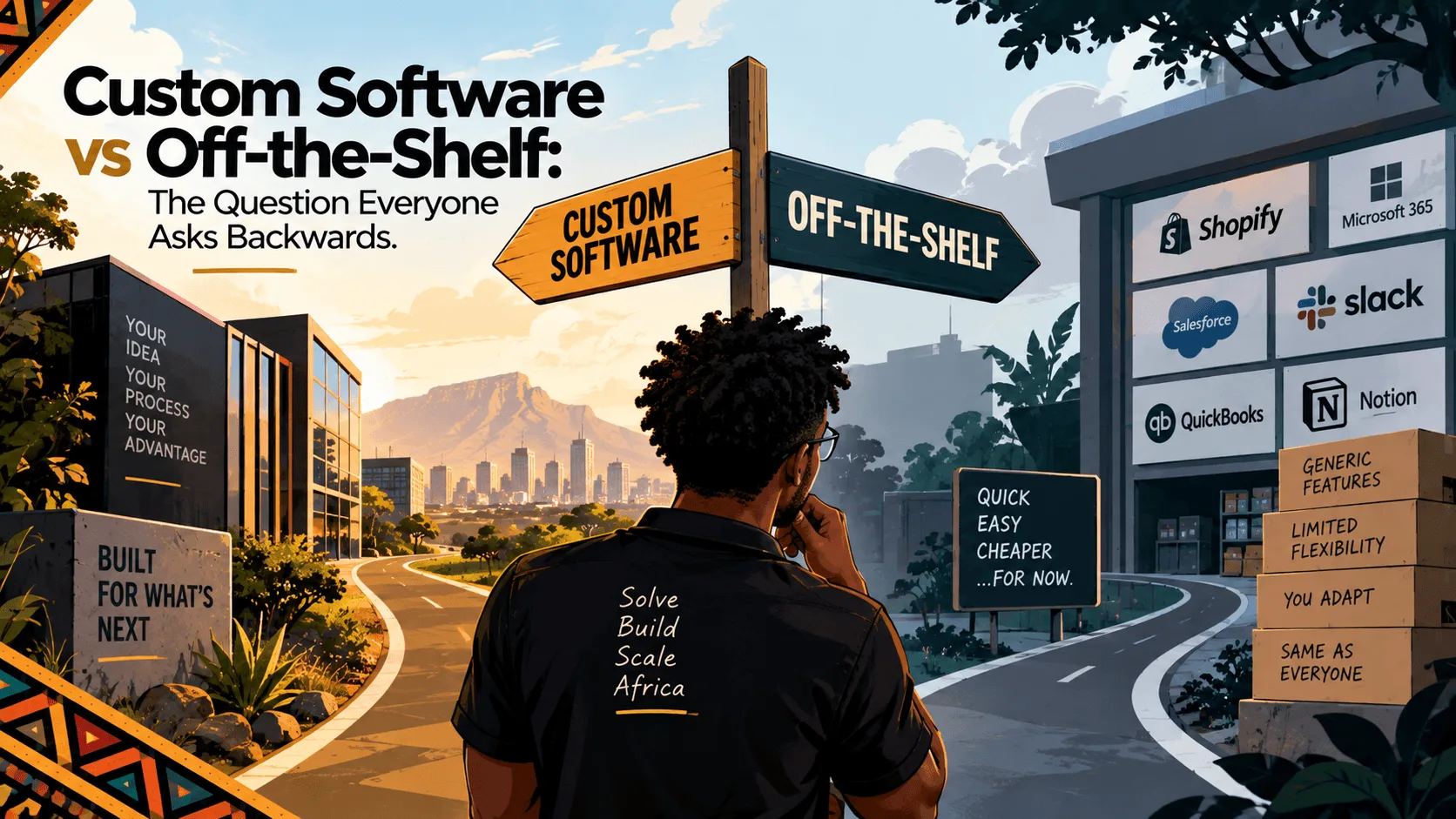
Every business that reaches a certain size hits the same crossroads. The spreadsheets are groaning. The free tools don't quite fit. And someone asks the question: do we buy off-the-shelf software, or do we build something custom?
It feels like a question about software. It isn't. And because business owners ask it backwards — starting from the tools instead of from the problem — most of them end up with the wrong answer, either overpaying for a custom build they didn't need or forcing their business into off-the-shelf software that quietly strangles them. Let me give you the way to actually think about this, because getting it right is one of the higher-leverage decisions you'll make.
The question everyone asks — and why it's backwards
The backwards version goes like this: "Off-the-shelf is cheaper and faster, custom is expensive and slow — so we'll use off-the-shelf unless we absolutely can't." Cost-first, tool-first. It sounds prudent. It leads people astray constantly.
Here's why. That framing treats your business processes as the thing that should bend, and the software as fixed. But your business processes are often the actual product — the specific way you do things is why customers choose you, why you're efficient, why you win. When you force that into generic software built for the average of ten thousand other companies, you're not saving money. You're sanding down the thing that makes you you to fit a tool built for someone else.
The right question isn't "what's cheaper?" It's: is the process I'm trying to support a commodity, or is it my competitive edge? Answer that, and the software decision mostly makes itself.
When off-the-shelf is exactly right
Let me be clear, because this cuts both ways: for a huge amount of what a business does, off-the-shelf software is the correct, smart, obvious choice — and paying for custom would be a waste.
The rule is this: if the process is generic — the same for you as for everyone else — buy it off the shelf. Email, accounting, payroll, calendars, basic document storage. There is no competitive advantage in having a custom email system. These are solved problems, the existing tools are excellent and cheap because the cost is spread across millions of users, and building your own would be burning money to reinvent a wheel that rolls perfectly well. Anyone who tells you to custom-build your email is selling something.
Off-the-shelf wins whenever the process is a commodity — something you need to have but that doesn't differentiate you. Don't build what you can buy, when what you can buy is genuinely as good for your purpose. Most of the software a business runs on should be bought, not built. That's not a compromise; it's good judgment.
When custom is the only real answer
Now the other side, and this is where businesses lose fortunes by choosing wrong. When the process IS your competitive advantage — the specific, particular way you operate that makes you better than rivals — off-the-shelf software will actively hold you back, and custom becomes not a luxury but a necessity.
Here's the trap of forcing a differentiated business into generic software. You have a workflow that's uniquely efficient, a way of serving customers that's uniquely good. You adopt an off-the-shelf tool that doesn't quite fit it. So you change your process to match the software — and in doing so, you throw away the very thing that made you special. You've paid money to become more average. The software was cheaper on the invoice and vastly more expensive in what it cost your business.
Custom software flips that. It's built around your process, so it amplifies your edge instead of erasing it. It fits how you actually work, scales with your specific needs, and — crucially — becomes an asset you own rather than a subscription you rent, subject to someone else's roadmap, price hikes, and priorities. When your operations are the product, the software that runs them should be yours.
Signs you've outgrown off-the-shelf and need custom: you're running your real business in spreadsheets alongside your "official" tools because the tools don't do what you need. You're paying for five different apps and gluing them together by hand. Your team wastes hours on workarounds. Your competitive process is getting harder to execute, not easier, because your software fights it. That friction is the sound of generic software strangling a business that has outgrown it.
The framework, in one line
So here's the whole decision, compressed: buy the commodity, build the advantage.
Map your business processes into two buckets. Bucket one: the generic stuff everyone does the same way — email, accounting, the basics. Buy those off the shelf, cheaply, and never think about them again. Bucket two: the specific ways you operate that make you better than your competition — your special sauce. Build those custom, because forcing them into generic tools destroys the advantage you're trying to protect.
Most businesses get this exactly backwards. They happily pay for expensive generic tools they could've bought cheaper, and they cram their competitive edge into software that flattens it. Flip it. Spend little on the commodity. Invest in the advantage. That's the decision, and it's not really about software at all — it's about knowing what actually makes your business win, and refusing to sand it down.
What to take from this
Custom vs off-the-shelf isn't a cost question, it's a strategy question. The moment you stop asking "what's cheaper?" and start asking "is this process a commodity or my competitive edge?", the answer becomes clear almost every time. Buy the generic. Build the differentiating. And be honest about which of your processes is actually which — because that's the judgment the whole decision rests on.
This is the exact conversation we have with businesses at Neocube. We'll tell you honestly when off-the-shelf is the smarter buy — and when your operations have become your competitive edge and deserve software built around them, not the other way round. When it's the latter, we build custom software (with AI built in) designed around how your business actually works. If you're stuck gluing five tools together or running your real business in spreadsheets, that's usually the signal.
Talk to Neocube →