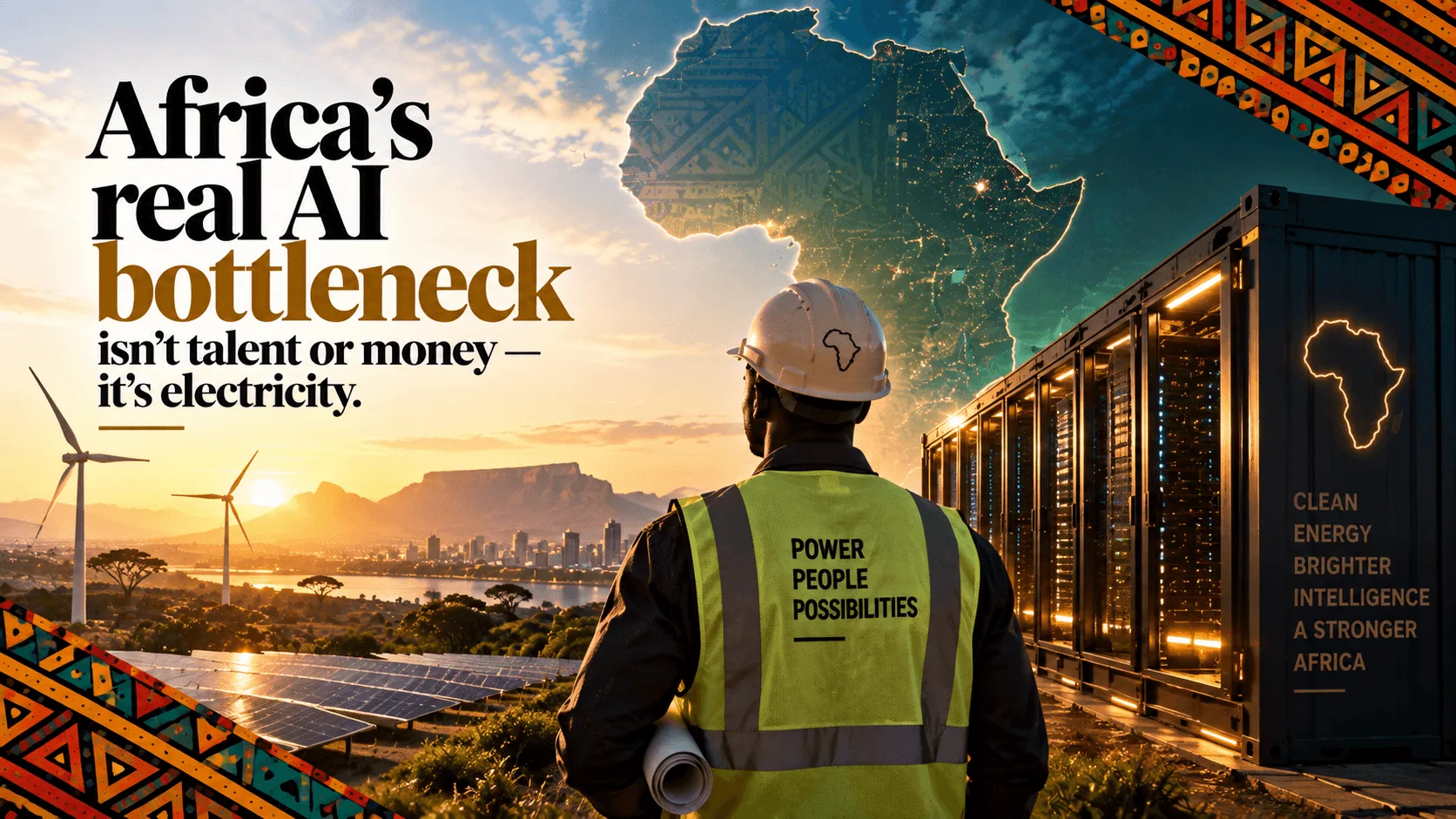
Every conversation about African AI eventually reaches for the same explanations for why the continent lags. Not enough talent. Not enough capital. Not enough data. All partly true. But they miss the constraint sitting underneath all of them — the one that's less exciting to talk about because you can't fix it with a clever app or a funding round.
It's electricity. Plain, physical, unglamorous electricity.
The IMF estimates roughly half of sub-Saharan Africa's population still lacks reliable access to power. And here's the brutal thing about AI: the data centers that run it need vast amounts of electricity, delivered continuously, without interruption. AI workloads can't tolerate the intermittent grid that much of the continent lives with. An AI data center that loses power isn't inconvenienced — it fails. So you can have all the talent, all the capital, and all the ambition in the world, and still be unable to build the AI economy, because the machines have nothing reliable to run on.
Nobody wants this to be the answer. It's not sexy. But I'd argue it's the single most important — and most overlooked — fact about Africa's technological future. And, like every hard constraint, it's hiding an enormous opportunity in plain sight.
Why power is the real foundation, beneath the foundation
I've argued before that compute is the foundation of AI. Let me go one level deeper, because compute itself stands on something: power. A data center is, at bottom, a machine for turning electricity into computation. No reliable electricity, no data center. No data center, no local compute. No local compute, no sovereign AI. The whole tower of African AI ambition rests, ultimately, on the power grid.
This is why so many well-intentioned AI initiatives quietly stall. You can train the talent and raise the money, but if the GPUs can't stay on, none of it compounds into infrastructure. It's also why the countries likely to win the African AI race aren't necessarily the ones with the most developers or the most startups — they're the ones that can offer reliable power, fibre, land, and regulatory certainty together. As one analysis put it bluntly: the countries that can provide dependable electricity will have the advantage in attracting AI infrastructure investment. Power is the entry ticket. Everything else is downstream.
For a continent used to thinking about its tech future in terms of software and skills, this is an uncomfortable reframe. The bottleneck isn't in the code. It's in the grid.
The opportunity most people walk right past
Here's where the pessimism should flip, because a hard physical constraint at the base of a trillion-dollar opportunity is one of the most valuable things in the world — for whoever solves it.
AI's insatiable, continuous demand for power is doing something interesting: it's creating a massive, bankable, long-term customer for electricity generation. A data center is the kind of steady, high-value energy buyer that makes building new power generation financially viable in a way that scattered household demand often doesn't. And because the demand is new, it can be built clean from the start.
This is already happening. At energy conferences across the continent, the conversation has turned to how AI and data-center growth could actually accelerate renewable energy investment — solar, wind — because these facilities need power and are willing to sign long-term deals to get it. New models are emerging: "wheeling" agreements where data centers buy directly from renewable providers, bypassing unreliable grids entirely. The World Economic Forum's framing of "green compute" captures the whole idea — Africa could build its AI infrastructure on renewable power from the ground up, turning its energy gap into a leapfrog the way it once leapfrogged landlines for mobile.
Think about what that means for opportunity. The intersection of AI's power hunger and Africa's renewable potential — abundant sun, abundant wind, and no legacy fossil grid to protect — is one of the richest, least-crowded frontiers on the continent. Solving African AI isn't only a software problem for coders. It's an energy problem for a whole different kind of builder — and the energy builders who see AI coming are looking at a demand signal that could finance the continent's power future.
The honest difficulty
I won't wave this away as easy. Building reliable power infrastructure is slow, capital-intensive, politically complicated, and physically hard. It's the opposite of a weekend project. The compliance and coordination burden is real — energy, digital, and land planning have to happen together, and often across fragmented jurisdictions. This is a decade-long, infrastructure-grade challenge, not a startup sprint.
But that difficulty is exactly why it's undervalued. Everyone crowds into the easy, visible layer — the apps, the models, the demos. Almost nobody wants the hard, physical, patient work at the bottom of the stack. Which is precisely why the bottom of the stack is where the durable value, and the least competition, sits.
The Bottom of the Stack
- No power, no AI. Compute stands on electricity; the whole tower rests on the grid.
- AI is a bankable power customer. Continuous, high-value demand can finance new generation — built clean from the start.
- Least crowded, most durable. Everyone chases the visible app layer; almost no one does the hard energy work underneath.
The story we tell about African AI is a story about talent and startups and clever applications. The story we should tell starts one layer lower, with the least glamorous input imaginable: keeping the lights on, continuously, at scale.
Africa's AI future will be built by whoever solves the power problem — because everything else, the compute and the models and the applications, depends on it and cannot exist without it. That makes electricity not a boring prerequisite but the most strategic opportunity on the continent, sitting at the exact point where the world's hottest technology meets Africa's greatest infrastructure gap and its greatest renewable potential. The builders chasing the visible layer are competing with everyone. The ones who go down to the power layer are competing with almost no one — for the foundation the whole thing rests on. Sometimes the biggest opportunity is the one nobody finds exciting enough to take.
References
- Business Day — Africa's AI ambition hits an expensive reality of compute, power, compliance
- World Economic Forum — Are Africa's power grids ready for the AI data centre boom?
- World Economic Forum — Investment in 'green' computing can unlock $1.5t in Africa
- AIFOD — AI and Data Center Expansion May Drive Africa's Renewable Energy Investments