Africa's greatest technology triumph is a story the whole world knows. The continent never built out landline telephone networks the way the West did — and instead of being a permanent disadvantage, that gap became a superpower. Africa leapfrogged straight to mobile, then to mobile money, and ended up ahead of rich countries on how everyday people move money. The absence of legacy infrastructure turned into an advantage. It's the proudest case study in African tech.
I want to warn that the same continent is now standing at an identical fork — with AI — and this time the leapfrog is not guaranteed. In fact, on the current path, the more likely outcome is the opposite: not leapfrogging ahead, but getting locked into a new kind of dependency that could last generations. Let me make the uncomfortable case, because I think it's the most important choice African tech faces this decade.
The dependency being built right now
Here's the trap, and it's subtle because it doesn't feel like a trap. It feels like convenience.
Today, when Africa "adopts AI," what mostly happens is this: African businesses and people use AI tools built by foreign companies, trained on foreign data, running on foreign compute, reflecting foreign contexts. The models are brilliant and available and cheap to start with. So everyone uses them. Adoption looks like success.
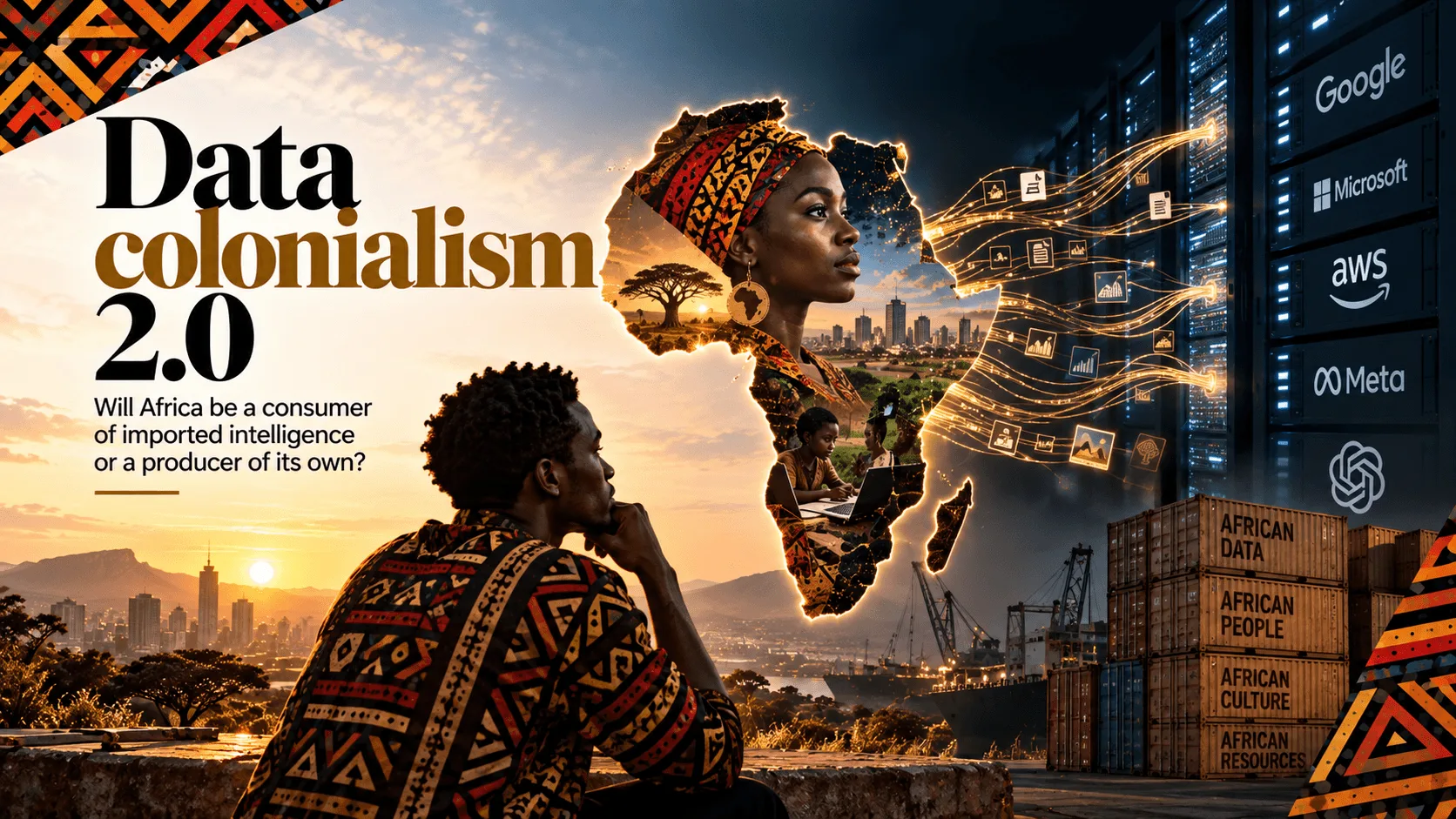
But look at what's actually being built underneath that adoption. The data flows out — African financial, health, behavioural, and business data processed on servers abroad. The intelligence is owned elsewhere — the models that learn from that usage belong to companies outside the continent. The money flows out — every query is rent paid to an infrastructure owner in another country. And the models don't even understand Africa well — trained on less than 2% African data, they fail in 90% of the continent's languages and carry contexts built for other places.
There's a name for this emerging in African policy circles, and it's deliberately provocative: data colonialism. The old colonialism extracted physical resources — minerals, crops, labour — and sent the value abroad, leaving the continent dependent. The critique is that the AI era risks doing the same thing with a new resource: data and intelligence. Africa provides the raw material (data, usage, attention) and the human need; the value, the ownership, and the control accumulate elsewhere. Consumption dressed up as progress.
I know "colonialism" is a heavy word. But the structural pattern — raw material out, finished value in, dependency entrenched — is worth taking seriously precisely because it's happening under the friendly banner of innovation, which is exactly what makes it easy to miss.
Why this fork is different from the mobile one
You might reasonably say: but Africa leapfrogged before. Why not again? Here's the hard part — the AI fork has a feature the mobile fork didn't, and it cuts the wrong way.
With mobile phones, once you had the handset and the network, you were a full participant. The technology was relatively finished; adopting it made you equal. AI is different because it compounds ownership over time. The companies that own the models and the compute today use the data and revenue from global adoption to build even better models tomorrow, which deepens everyone's dependence, which funds the next round. The gap doesn't close as you adopt — it can widen, because your usage is feeding someone else's advantage. Renting AI isn't a stepping stone to owning it. It can be the thing that ensures you never do.
That's why "just adopt the foreign tools for now" is more dangerous than it sounds. In mobile, adoption was the leapfrog. In AI, pure adoption without ownership can be the opposite of a leapfrog — it's boarding a train as a permanent passenger on someone else's line.
The other path — and it's real
Now the hopeful part, because this is a choice, not a fate — and Africans are already choosing differently.
The alternative to consuming imported intelligence is building sovereign intelligence: African-owned compute, African-language models, African-controlled data, infrastructure that stays on the continent. And it's not a fantasy. Local-language models like InkubaLM are being built by African companies. Six major telecom operators have united to build AI "in Africa, by Africa, for Africa." Countries like Kenya are writing national AI policies explicitly framed around digital sovereignty — local infrastructure, local compute, local talent. Research collectives are creating the open African datasets the giants never bothered to build. The movement toward "linguistic sovereignty" and "technical sovereignty" is real and gaining momentum.
This is the leapfrog path — but it requires doing the harder thing. Not just using AI, but owning pieces of the stack: the data, the models, the compute, the infrastructure. It's slower and costlier than plugging into a foreign API. It's also the only version where Africa ends up ahead instead of dependent, the way it did with mobile.
Two Paths That Start Identically
- Consumption: use the foreign tools, enjoy the convenience, wake up a permanent tenant — data and value flowing out, the gap wider than before.
- Sovereignty: build the harder thing — owned compute, owned models, owned data — and leapfrog the way the continent did with mobile.
- The catch: in AI, adoption alone is not the leapfrog. Ownership is.
Africa faces a genuine fork, and the two paths look almost identical at the start — both begin with "adopt AI" — but they end in opposite places. One path is consumption: use the foreign tools, enjoy the convenience, and wake up in a decade as a permanent tenant in the most important economy of the century, your data and value flowing outward, the gap wider than when you started. The other is sovereignty: build the harder, deeper thing — owned compute, owned models, owned data — and leapfrog the way the continent has leapfrogged before.
The mobile-money miracle happened because Africa built and owned something, not because it borrowed something. That's the lesson worth carrying into the AI age, and the warning worth heeding: adoption alone is not the leapfrog. Ownership is. The continent that skipped landlines and won gets to make that choice again — and this time, the easy path and the winning path are not the same one. Which one African builders, investors, and governments choose in the next few years may matter more than almost anything else they do.
References
- African Leadership Magazine — Africa's AI Imperative: Avoiding Data Colonisation Through Sovereignty
- Research ICT Africa — Architecting African linguistic sovereignty
- African Leadership Magazine — Africa's Data Sovereignty Push Sparks A New Race For Local Language AI
- Nature Middle East — As AI giants duel, the Global South builds its own brainpower